


The platform remains free (and worth it) but in case you’re feeling philanthropic, I’ve set up a subscription page!

“In general, though, the modern tendency was to feel rather than to think; so that men were now more highly esteemed for inventing new diversions than for preserving old facts or pushing back the frontier of cosmic mystery.” The Mound, by H. P. Lovecraft and Zealia Bishop
“You have no idea how easy you have it. Back in my day…” said every older generation to every younger generation since the dawn of time. And sure, due to climate change winter snows were probably deeper for longer periods of time when walking to school. And some generation a thousand years ago dealt with barbarian invasion. Edgar the Peacemaker probably told his son Æthelred the Unready, “You have no idea how easy you have it…” but was conveniently not around when Swein Forkbeard of Denmark took over England in 1013.
English succession gets terribly complicated through 1066. And what one generation experiences cannot map against the trials and tribulations of the generation before or after without some kind of contextual adaptation. Case in point: last month my younger son had midterms. They were his first midterms. I asked how they were going, and when I wanted to know what was expected and how long they took, he was a bit indignant.
“They’re midterms. You had midterms.”
Uh, actually, no, not in high school. We had periodic exams in high school, pop quizzes, papers, and presentations, which eventually led to finals at the end of the year. But I did not have a week of concentrated exams in the middle of January, two hours for each subject, two subjects a day, releasing students from school early, presumably to prepare for the next day’s subjects on Chromebooks. For better or worse, my education was very much still built on the three Rs.
Reading
“Literature was all highly individual and analytical, so much so as to be wholly incomprehensible…” The Mound
While the three Rs date to an era before English (legere et scribere et numerare discitur) their foundation as corneRstones of education dates to the early 19th century when both England and America were establishing models of public instruction. You may recall from my last podcast on nonprofits that the first public high school in the US was founded in 1821, smack dab in the middle of the growing Athenæum movement. Matt Burriesci talked about the Providence Athenæum’s collection of useful and edifying books. We also talked about the possible theoretical role of AI at the Athenæum.
But what about the actual impact of AI in education?
’riting
“Art and intellect, it appeared, had reached very high levels in Tsath; but had become listless and decadent. The dominance of machinery had at one time broken up the growth of normal aesthetics, introducing a lifelessly geometrical tradition fatal to sound expression.” The Mound
The QWERTY keyboard took root in English-typing countries a hundred and fifty years ago. And with it marked the slow death of cursive, as well as legible handwriting. But in the ultimate “Back in my day…” Plato recounts Socrates telling Phaedrus in 360 BC that upon the invention of writing by the Egyptian god Thoth, Ammon warned that it would lead to the ruin of men:
If men learn this, it will implant forgetfulness in their souls; they will cease to exercise memory because they rely on that which is written, calling things to remembrance no longer from within themselves, but by means of external marks. What you have discovered is a recipe not for memory, but for reminder. And it is no true wisdom that you offer your disciples, but only its semblance, for by telling them of many things without teaching them you will make them seem to know much, while for the most part they know nothing, and as men filled, not with wisdom but with the conceit of wisdom, they will be a burden to their fellows. Phaedrus, R Hackforth, transl., 1952
’rithmetic
“Science had been profound and accurate…Of late, however, it was falling into decay, as people found it increasingly useless to tax their minds by recalling its maddening infinitude of details and ramifications. It was thought more sensible to abandon the deepest speculations and to confine philosophy to conventional forms.” The Mound
Back in my day, we were allowed to use graphing calculators for math. The Texas Instruments TI-85 was cutting edge technology for plotting graphs and solving equations in (pre-)calculus. If Ammon was worried that writing would implant forgetfulness from a reliance on what was written, he had no idea what calculators would let us forget in arithmetic. Let alone Chromebooks. Thankfully, I can still chuckle when I hold a calculator upside down and look at “5318008” on its liquid crystal display.
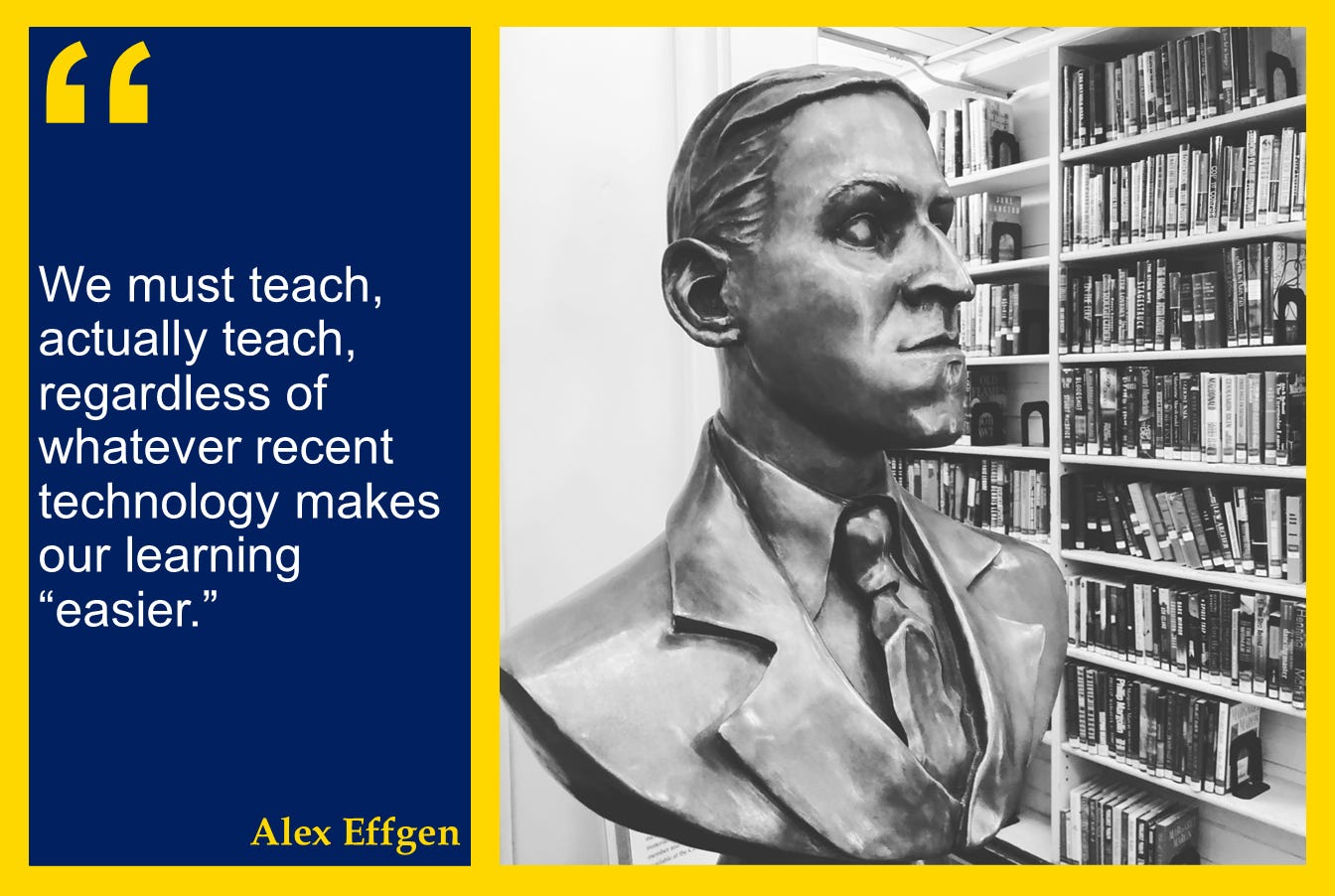
The wisdom of Ammon is the secret to education: “...by telling them of many things without teaching them you will make them seem to know much, while for the most part they know nothing…” We must teach, actually teach, regardless of whatever recent technology makes our learning “easier.”
In Related News…
Throughout this ramble I have sprinkled quotes from a lesser known work of Providence writer of the weird, fantastic, and horrific, Howard Phillips Lovecraft, who depicted an encounter with an ancient race whose technology bestowed both divine power and regressive indolence. He composed The Mound ninety-six years ago, so we’ve collectively speculated on the decadence brought by technology not only in the Classical but industrial eras as well.
Next week, The Future Indicative talks to my friend Rob McIsaac about motorsports. It had not started as a conversation about motorsports. It had started about the impact of technology on insurance and financial services. But before we changed topic to what he’s incredibly commemorating at Daytona International Speedway next month, we got into the need for responsive business process when dealing with new technology:
McKinsey talked about artificial intelligence and its utilization in financial services broadly. And they focus on agentic AI. And that actually gets back to the question of business process. And the point that they made is that you cannot just apply agentic AI against existing business process, which is akin to putting lipstick on a pig.
Don’t just take the new technology implied against old process. What you get then is old process which magnifies the flaws that goes very fast and is very difficult to correct. Maybe what you need is new process. Maybe what you need is to fundamentally rethink how you’re going to do some of these things. Step back and reconsider your processes based on the capabilities of the technologies.
And that is really hard. It has some really significant challenges for the insurance industry, which has—irrespective of line of business that you talk about—long to extremely long liability tails, as distinct from retail businesses or banking. That’s an article that people should take note of, particularly as they consider how they want to invest finite resources in getting after the kinds of outcomes that they’re going to need in the near and long term.
And I would just capstone that by saying that it’s worth reading that article in the context of a Bill Gates quote from a book he published in 1995. The title of the book was The Road Ahead. And the quote is that “We always tend to overestimate the impact of technology in the near term, and underestimate the impact of new technology in the long term.”
And so it’s really important to think about where we’re going and how we’re going to get there, because we’re not gifted with unlimited resources and the economic pressures are going to build.
Seems relevant advice for business, education, and preventing ruin. Ammon would approve! Meanwhile, feel free to familiarize yourself with these resources ahead of our conversation next week:
RPM Ventures and Rob McIsaac’s “Third Act”
The BMW 50th Anniversary Celebration at Daytona International Speedway (6-7 March 2026)
Cycle magazine
Winning’s Winning (The Fast and The Furious)
Racers, start your engines!
Alex Effgen