

The Present Indicative, 10 March 2026
My Current Mood: The Human Element

The platform remains free (and worth it) but in case you’re feeling philanthropic, I’ve set up a subscription page!

“People. What a bunch of bastards.” Roy, The IT Crowd
Last week I caught fire with a LinkedIn comment. Over 3800 impressions with 2700 members reached. Got 12 reactions and it drove 18 profile views. I didn’t say it was a conflagration. Just a little bit of human reaction to a post about Claude suffering a “temporary service disruption” and James Hawkins noticing 14 coworkers suddenly not responding to any messages he sent to them. A bit of fun while we’re all re-adjusting our workflows to accommodate the machines.
My last post the week before did not get such attention. 178 impressions. Just over 100 members reached. It got 8 reactions but did not drive any profile views. This post was not a reaction to another member of the Matrix. Just an original thought that came out of my podcast (not hosted on LinkedIn).
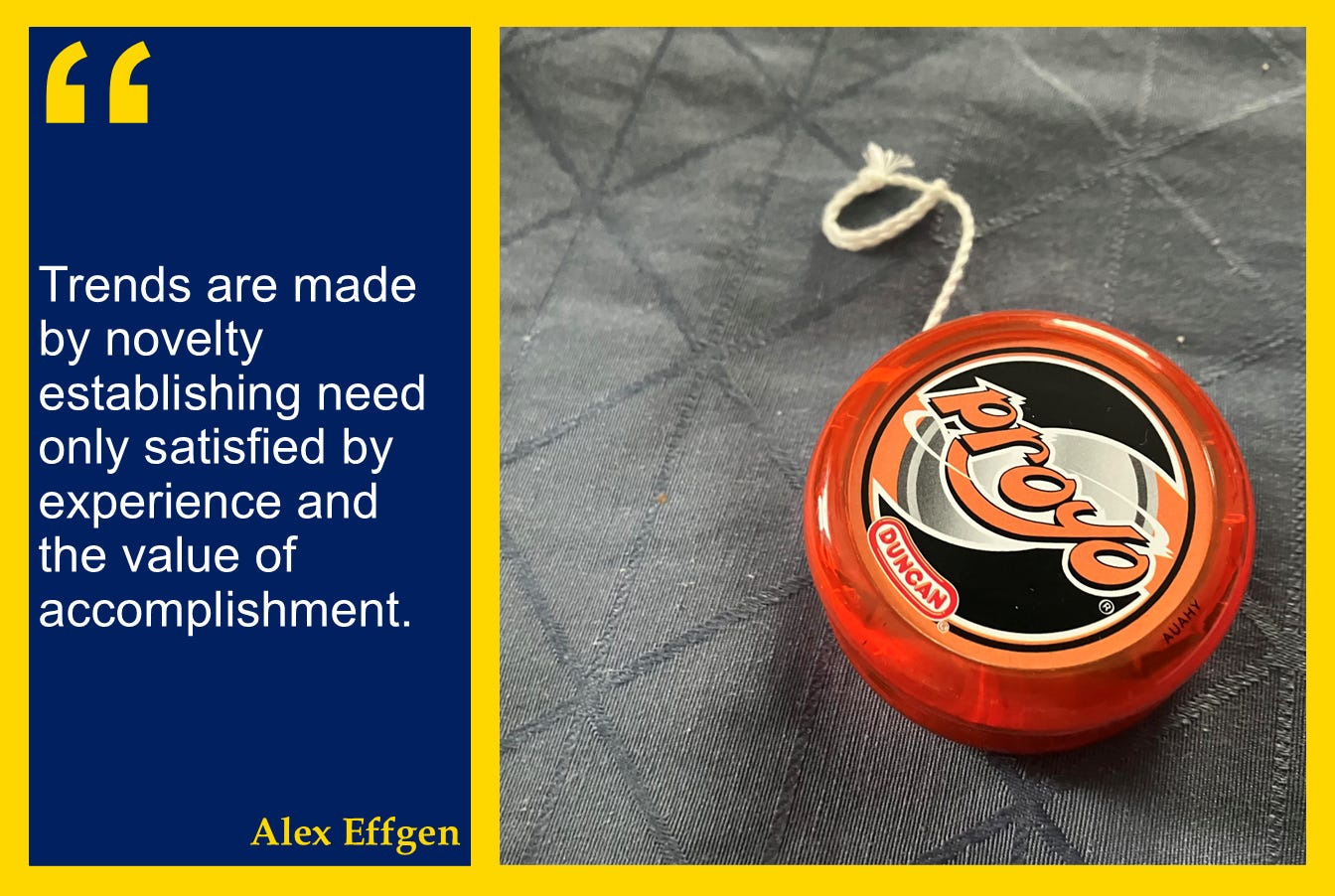
Well, they call it an algorithm. And algorithms are known for their curves. Things go up and down. Sometimes you’re up, and sometimes you’re down. Just like yo-yos. In a strange twist my younger son, who prefers to live his life online, found one of my old Duncans, and began to play around with it.
“I like being weird. Weird is all I’ve got. That, and my sweet style.”
You’ve seen my headshot. I have a green beard. OF COURSE I spent a chunk of my lonely childhood learning how to walk the dog, shoot the moon, and rock the baby. I just did not think it would be inherited. My boy started as we all start: dropped it straight from his hand towards the floor. Sometimes it came back. Sometimes it didn’t. I watched his frustration rise. I offered to help.
“NO! I got this,” he protested. Merits for persistence. Demerits for stubborn defiance against subject matter experience. He asked to practice in front of the living room television, and noticed the Prime platform recommended The IT Crowd. He also inherited my love of British comedy.
“Hello IT, have you tried turning it off and on again?”
For the uninitiated, The IT Crowd is a Channel 4 series, written and directed by Graham Linehan, and starring Chris O’Dowd, Richard Ayoade, and Katherine Parkinson as the primary members of a large London corporation’s IT department. The series is grounded in the logic of the business world undone by the illogical choices of the people working in that world, or worlds–as there is often a disconnect between those who troubleshoot the information technology and the business folk literally above them in their stratified building. The show is silly, farcical, and often accurate. I’m quoting from it in my subheadings.
The comedy disarmed my son’s stubbornness, enough to watch me wrap the yo-yo string around the outer knuckle of my middle finger and snap my wrist in a motion that rocketed the plastic wheel down to the ground, spin in place, and then return to my hand with the slight tug of that digit. I then sent it out parallel to the ground and pulled it back like Spider-Man slinging webs. It was enough demonstration to re-set his attention in the right direction. He improved drastically by the end of the next episode.
“The elders of the Internet know who I am?”
Two days later he returned from school and I noticed the yo-yo in his hand. “Still practicing?” I asked.
“Yes,” he said.
“Wait, did you bring that to school?”
“Yes,” he said again.
“Are you practicing at school?” It dawned on me this could cause trouble.
“Yes,” he repeated.
I needed to ask a question that prompted more details. “When and where are you practicing yo-yo at school?”
“At the end of class when I’m done with work.”
“And the…teachers…don’t have a problem with you doing it?” I had to be sure.
“Nope!”
He did not fill me with confidence, but I must assume the teachers are just happy he’s not fixed to a phone. It’s all fun and games until he shoots the moon at a glass beaker of acid. “What do the other kids think?”
“Oh, they all want one.”
Of course they do. Because trends are made by novelty establishing need only satisfied by experience and the value of accomplishment. Credit my lonely childhood.
“If you type ‘Google’ into Google, you can break the Internet.”
If only social media were as easy as learning to yo-yo. There’s a lot of things breaking the internet these days, and compromising its value. I’m not the only one to notice a decrease in impressions when posting on LinkedIn. Maybe you’ve experienced it as well. A few weeks back an estimable colleague posted a benchmarking seminar for financial services. It got 26 impressions and he supplicated Higher Powers in his reaction. I felt compelled to share my own impression of what’s transpiring. The Facebooking of LinkedIn. Between AI content dilating/diluting the feed, and an increase in overpersonalized sharing, I don’t see how LinkedIn remains an ecosystem for professionals to showcase their perspective for the benefit of other like-minded subscribers that are trying to become better professionals.
Of course, there are cheat codes. And me commenting on Claude suffering a “temporary service disruption” points towards what LinkedIn now rewards: commenting. All of us should take some good advice instead of going at it on our own and not getting any better with practice. But at some point, if you’re only chasing the algorithm, then you’re repeatedly raising your hand in class to hear yourself speak instead of sharing something insightful. Maybe take some time once you’re done with work and practice something else. Something meaningful. Who knows, maybe you’ll build your own trend.
In Related News…
It’s quaint to see trends develop between people. No SEO, GEO, keyword, hashtag, hoodwink bought and boosted for the hype while avoiding the insight. How we internet is changing, and I spoke to my friend, Alicia Clapper, an expert on the customer journey, on how it’s changing:
Recently I’ve seen people using AI search engines as a way to shop and as a starting point: to plug in what they’re looking for, specifics of what they need, and using that to search different brands.
And they’re not brand loyal. They’re just looking for a product that will suit their needs and using AI as a starting point to find that, which is interesting because it cuts through all of the marketing that any D2C company does and puts out there with ads or emails. You’re not seeing any of that. You’re getting directed to a specific product or a specific brand, and having a direct path to that website from this AI search engine.
So I found that as something interesting that people are doing. They are high intent. So typically, when they get to the recommended site from AI. They trust that. The bounce rate is lower, they’re more likely to trust that recommendation and shop from that site. It cuts through all the marketing efforts that are out there. And it’s just a new method for direct traffic.
The AI may now make the choice easy, but once you have the customer, what kind of journey does your online store make them take to the point of sale? Next week on The Future Indicative we talk about the user interface (UI) and the user experience (UX), and it’s worth a listen.
If you want to learn a little bit about AI in search engines:
“AI Is Taking Over Your Search Engine. Here’s What It’s Doing and Why It Matters”
“New front door to the internet: Winning in the age of AI search”
And a few resources from next week’s episode include:
The Future Indicative: Nonprofit (Part 1)
The Future Indicative: Cybersecurity (Part 1)
US Census: sales totals in Q3 2025
Enjoy!
Alex Effgen