

The Present Indicative, 13 January 2026
My Current Mood: Chained to Media

The platform remains free (and worth it) but in case you’re feeling philanthropic, I’ve set up a subscription page!

“If convictions don’t cost anything then they’re really just fashion. They’re not really conviction.” Barack Obama, WTF, Episode 1686
My wife likes True Crime. She also consumes Jane Austen, which I mentioned in another life, and I do worry how these genres intersect in her consciousness (probably Northanger Abbey and not The Staircase). Anyway, life’s all about murder and romance but recently she discovered a Netflix series called Unlocked: A Jail Experiment. It identifies as a docuseries set in Southern detention facilities (Arkansas in Season 1 and Arizona in Season 2), where inmates are given more autonomy and responsibility by having their cell doors unlocked.
So she’s graduated from means, motive, and opportunity to punishment and rehabilitation. While it’s cutting into my time watching Edwardian Farm on Tubi, I philosophically gravitate towards prison models that promote positive reinforcement and rehabilitation methods that attempt to avoid the unintended consequence of dependence. And she’s bingeing it, so who am I to purge. Will the jail experiment foster community and a nascent willingness to transcend their statistical recidivism? Or…are the inmates who society thinks they are: born wrong and therefore deprived of freedom to protect our security?
Actions Have Consequences
Documentaries are huge right now on all platforms. We’re no longer living in the era of Frederick Wiseman’s Titicut Follies: either in documentary production or subject. Wiseman’s film explored the dehumanizing nature of institutions and was subject to government censorship. Nowadays documentaries are a cheap means of entertainment and transcend all genres including fiction, be it horror (Blair Witch), comedy (The Office), or both (C-SPAN). Judd Apatow wrote and directed The 40-Year-Old Virgin over twenty years ago. His IMDB is now littered with documentaries on George Carlin and Mel Brooks, as well as Stormy Daniels and the Parkland high school shooting.
Documentaries are all pretty great. Formulaic, but great. Both seasons of Unlocked introduce the inmates, their nicknames, their real crimes, their environment, and their jailors, including the sheriffs whose reputations are at stake treating convicts like citizens. The series establishes a dichotomy of impetuous youngsters and mindful oldheads all trying to improve their circumstances, and at times taking advantage of their limited freedoms.
Rights vs Privileges
But of course, somewhere in the middle of each season, the unscripted narrative casts doubts on the experiment. Perhaps the inmates have taken too much liberty by smuggling drugs into the pod by means of their gastrointestinal tracts, or talking back to a guard who–in interview–admits to doubts about the experiment’s potential. Oh so many times the sheriffs explain to camera that they’re not sure if this experiment will work.
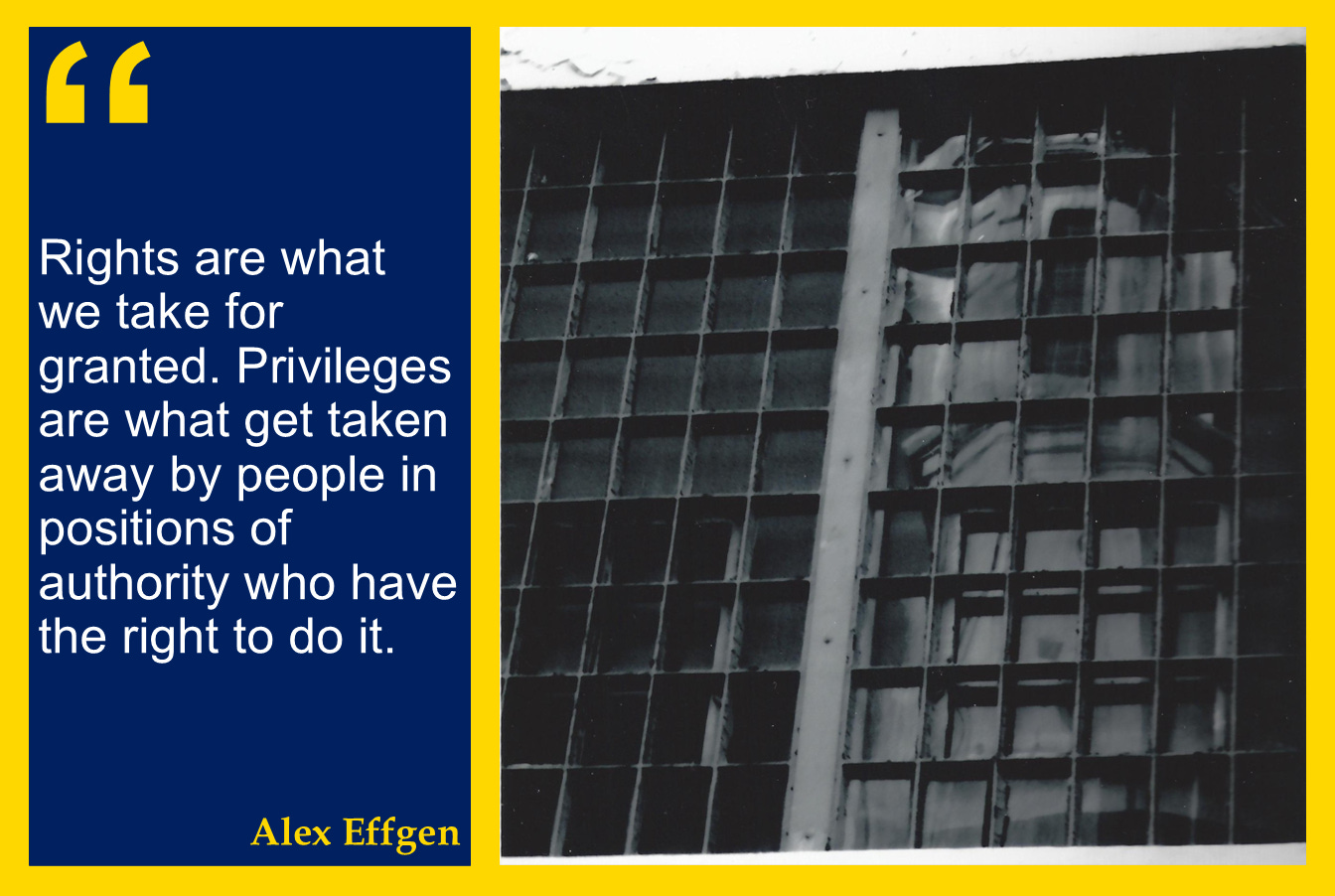
Do I need to spoil the ending? No. Let’s just say both seasons the sheriffs need to lock everything back down and show the difference between rights and privileges. Rights are what we take for granted. Privileges are what get taken away by people in positions of authority who have the right to do it. And it’s great for ratings. Compelling drama.
Inmates Running the Asylum
In the very last episode of Marc Maron’s podcast, WTF, Maron interviews former president Barack Obama to realign his own emotional compass within the magnetic storm of media and politics driving everything crazy. Both Maron and Obama have served their terms mediating the polemics, each within their respective spheres of influence. And just like Solon (and many in between) both said, “We’re done. It’s up to you.” And reclaimed what they could of their lives to avoid further involvement.
Anyway, President Obama said the two sentences in that interview to make up the newsletter quote above: “If convictions don’t cost anything then they’re really just fashion. They’re not really conviction.” When the system has reached a point where criminals have the system’s authority to treat our rights as privileges, how do we turn fashion into conviction?
In Related News…
The Future Indicative is here to help answer my question!
The Future Indicative, Ep 5 Part 1
The Future Indicative, Ep 5 Part 2
We have Matt Burriesci to orient our listeners to nonprofits, and in particular, the Providence Athenæum. Among the many answers Matt provides to my questions, I found this one very relevant.
The Athenæum allows people to think for themselves. It allows people to critically engage with literature on their own terms and to set their own path. And that’s something that was very true from the founding, that this was an institution founded sort of on a rugged principle of self-improvement. We don’t prescribe a path for you. You come in and you find your own path. We are here to support that. We are here to support the individual pursuit of wisdom…We’re not here to reinforce whatever’s in your echo chamber. You’re here to experience different ideas and to engage with them on your own terms. And I think that’s something that’s very sorely lacking in our echo chambers and our information silos.
When we want to break from our chambers and silos, our pods and our prisons, the first place to look is in a book. Consider Denmark.
HAMLET: Denmark’s a prison.
ROSENCRANTZ: Then is the world one.
HAMLET: A goodly one, in which there are many confines,
wards, and dungeons, Denmark being one o’
th’ worst.
ROSENCRANTZ: We think not so, my lord.
HAMLET: Why, then, ’tis none to you, for there is
nothing either good or bad but thinking makes it
so. To me, it is a prison.
ROSENCRANTZ: Why, then, your ambition makes it one.
’Tis too narrow for your mind.
HAMLET: O God, I could be bounded in a nutshell and
count myself a king of infinite space, were it not
that I have bad dreams.
GUILDENSTERN: Which dreams, indeed, are ambition,
for the very substance of the ambitious is merely
the shadow of a dream.
Sounds like Hamlet could have used a good book. Might I suggest Northanger Abbey?
Enjoy!
Alex Effgen