

The Present Indicative, 14 April 2026
My Current Mood: Surviving and Thriving

The platform remains free (and worth it) but in case you’re feeling philanthropic, I’ve set up a subscription page!

“But Natural Selection, we shall hereafter see, is a power incessantly ready for action, and is as immeasurably superior to man’s feeble efforts, as the works of Nature are to those of Art.” Charles Darwin, The Origin of Species
I often wonder what Darwin would think of artificial intelligence. Sure, we could dump all of his writing into an LLM and animate his photographs to form a creepy avatar that answers questions by looking for commonalities in his past words and deeds, “who” regurgitates those commonalities in the semblance of original thought. Or…we could just read his actual words and apply critical thinking to bridge the context that informed him with the circumstances that influence us?
The novelty of the former receives billions of dollars of investment, while the latter requires an investment in higher education to resume teaching the humanities instead of bestowing technical degrees, as colleges continue to close their doors due to the high cost of tuition impacting enrollment (with AI tearing at its underbelly). Not that I’m here to talk about the failure of the Academy. We can save that for another time. I’m just grateful to have studied the Classics (as I still pay off my loans). It’s worth the monthly payment, even in the twilight of our Darkening Age, I tell myself.
“Until recently the great majority of naturalists believed that species were immutable productions, and had been separately created.”
Take the crab, for instance. Or more specifically, not the crab. We malign these decapods by tying their Latin name to illness: cancer. And then when we want to get technical about what kind of cancer, we use the Greek root of their name: carcinoma. But the problem that develops when you reapply antique words to modern topics is they can be re-applied to disparate studies. Carcinization, (or carcinisation) is not the act, process, or result of making cancer, but it is the act, process, or result of making a crab.
We have known, since thirty years after Darwin’s death, that Nature loves to make crabs: flattening and widening the carapace, fusing sternites, and bending the pleon.
“From the strong principle of inheritance, any selected variety will tend to propagate its new and modified form.”
Of course, when we say “Nature” we don’t mean to infer some higher intelligence willing to independently evolve at least five groups of decapod crustaceans into the form and shape of a true crab. Again, outside the topic of debate for this little newsletter. Whether victims of intention or circumstance, we have a lot of crabs. Some of them are not actual crabs. And this was not a subject of popular consideration until it got memed in 2019.
Forces outside our individual control impose advantages (or disadvantages) to individuals based on the immediate imposition of those forces applied to minor mutations in biology that get reinforced and specialized over millions of years. If you are willing to believe in the scientific method.
“Furthermore, I am convinced that natural selection has been the most important, but not the exclusive, means of modification.”
Of course, we apply evolution to many things, including our digital existence. Fifty years ago, Richard Dawkins published The Selfish Gene, which argued for a gene-centered view of evolution. The more genes two individuals share, the more sense it makes for them to cooperate.
The book also introduced the term meme for a unit of cultural transmission, analogous to the gene, and adopted by Mike Godwin in 1993 to define the way a unit of content proliferated through early online communities, including message boards, Usenet groups, and email. Things were getting viral.
“Man selects only for his own good; Nature only for that of the being which she tends.”
Crazy as it is (for me), I launched Indicate Marketing six months ago. Besides declaring my intention to share interesting stories that come from reliable sources, and hope to earn your trust, my friend Matthew Josefowicz shared an article from Harvard Business Review about the impact of AI workslop on organizations.
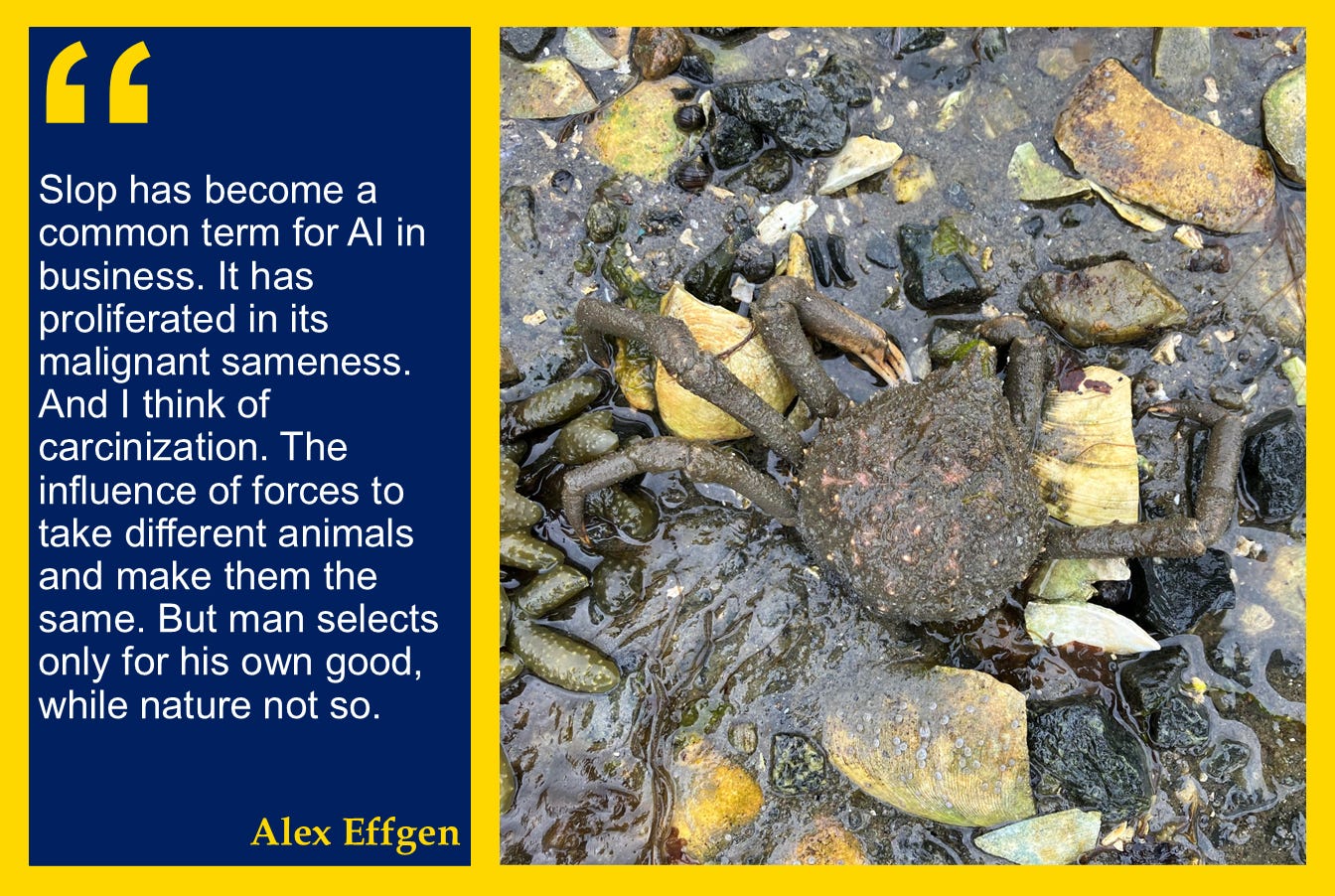
Slop has become a common term for AI in business. It has proliferated in its malignant sameness. And I think of carcinization. The influence of forces to take different animals and make them the same. But man selects only for his own good, while nature not so.
Later on in that same paragraph Darwin asks: “Can we wonder, then, that Nature’s productions should be far ‘truer’ in character than man’s productions; that they should be infinitely better adapted to the most complex conditions of life, and should plainly bear the stamp of far higher workmanship?”
We should aspire to make things like nature, while AI attempts to make things like man. Do you know what I meme?
In Related News…
Riffing on evolution, my friend Stephanie Dalwin is a comedian. A stand-up comedian. And next week she helps me understand stand-up as a business in good standing:
As a comedian, if you’re not reading, you’re not informing your work. You can always tell which comedians don’t read, we’ll say that. Most of the articles I read come from New York Times. While interesting, they’re very depressing.
I’ve been really getting back into The Oatmeal lately. They’re more like graphic novel articles. Graphic articles in defense of the naked mole rat.
It was a fantastic read. I highly recommend it. I like a strong controversial stance on something extremely low stakes. At one point they were described as naked skin cucumbers. I apologize to The Oatmeal if I misquoted them, but yeah, learned a lot about mole rats. I didn’t know that an article could paint mole rats in a sympathetic light, and yet here we are.
I really like learning how different folks from different mediums lay out language and think about language. I’m going on a long-winded rant. I promise I’ll land the plane. But in my professional work, and really in comedy, too, I love working with graphic designers, videographers, just because they think about laying out language and laying out a presentation of information in such an interesting way, and in such a way that I would not think of as someone who does not work in those mediums.
What I really liked about this article was how it laid out its arguments and its information. I think the pacing was more interesting just because you can have this visual interruption from a clever drawing or you superimpose one box over another so you can play with cadence and flow a little bit.
So it actually really forced me to think about my stage writing, and just writing in general. How I write professionally, laying out a presentation.
We start with naked skin cucumbers and wind up on last month’s topic, UI/UX. Very excited to share more next week.
But as we talk a lot about comedians, here are some proper nouns to know…
Conan O’Brien Needs A Friend (Denis Leary)
Bill Cosby’s I Started Out as a Child
Kevin Rooney (comedian, not the boxer)
“The Road Not Taken,” by Robert Frost
Enjoy!
Alex Effgen