


The platform remains free (and worth it) but in case you’re feeling philanthropic, I’ve set up a subscription page!

“Time flies over us, but leaves its shadow behind.” Nathaniel Hawthorne, The Marble Faun
Last week my older son turned seventeen. This month I’ve lived in my house for two decades. This year marks four centuries when a company of English fishermen took over the Native American settlement of Naumkeag–later rebranded Salem, Massachusetts.
2026 is a procession of anniversaries, where we return to commemorate a moment, or rather we note the moment when something turns, for the better or worse: Latin annus meaning “year” and versus, the past participle of vertere, meaning “to turn.”
We’ve discussed nostalgia. You can’t be nostalgic if you live in the now. But how narrow can we live without the context of our history? How selfish our perspective without a past? We live in time’s shadow. The author of our opening quote, Nathaniel Hawthorne, published the last of his complete historical romances in 1860, and thought his efforts infernal nonsense, but as his wife Sophia told her sister: “As usual, he thinks the book good for nothing...He has regularly despised each one of his books immediately upon finishing it.”
Haven’t we all.
“In my native town of Salem, at the head of what, half a century ago, in the days of old King Derby, was a bustling wharf—but which is now burdened with decayed wooden warehouses, and exhibits few or no symptoms of commercial life...”
Hawthorne’s most famous work, The Scarlet Letter, begins with a stand-alone preface almost as famous. The Custom-House introduces the motives of the author and establishes his time and place. He lived in a very different Salem than I do. My Salem has a commercial life that swells every summer and explodes in the autumn, only to hibernate, germinate, and propagate a new crop of horror the next year. Tourism is our industry and unhistorical witches are our product and service.
That was not always the case, but Hawthorne helped that along with his next study of the romantic and tragic.
“But as for the old structure of our story…So much of mankind’s varied experience had passed there,—so much had been suffered, and something, too, enjoyed,—that the very timbers were oozy, as with the moisture of a heart. It was itself like a great human heart, with a life of its own, and full of rich and sombre reminiscences.”
Past the witch museums and repopulated wharfs full of restaurants and broom boutiques, we have our House of Seven Gables. It was a book I had known before I bought my own Cape-style with two gables. We don’t tabulate prosperity by the total gables; just the total experiences saturated in the timber. A lot of happiness. A lot of sorrow. A lot of living. All better than the alternative.
Twenty years seems forever if I backdate 2006 to 1986. What happened in these last twenty years to make them fly by?
“Let me say outright, for once, that he is a sweet and lovely little boy, and worthy of all the love that I am capable of giving him.”
Children. Children take our life. Children take our health. Children take our sanity. But they also shine a youthful beam that dispels the shadows of our maturity (if we let them). Hawthorne illustrates this in a private record of the three weeks he spent alone with his 5-year old son in the summer of 1851, posthumously published as Twenty Days with Julian and Little Bunny by Papa in 2003, and a copy I borrowed from the Salem Public library anticipating the birth of my first born.
Unlike the standards of their day (speak when spoken to), the Hawthornes indulged their children. Treating them as equals rather than intimidating their instincts. It would influence my own parental aspirations. Years later, in his own writing, Julian Hawthorne, born in Salem like both of my boys, would note: “Children, brought up naturally and in freedom, not only have imagination, but live in a world of imagination more real to them than our reality.”
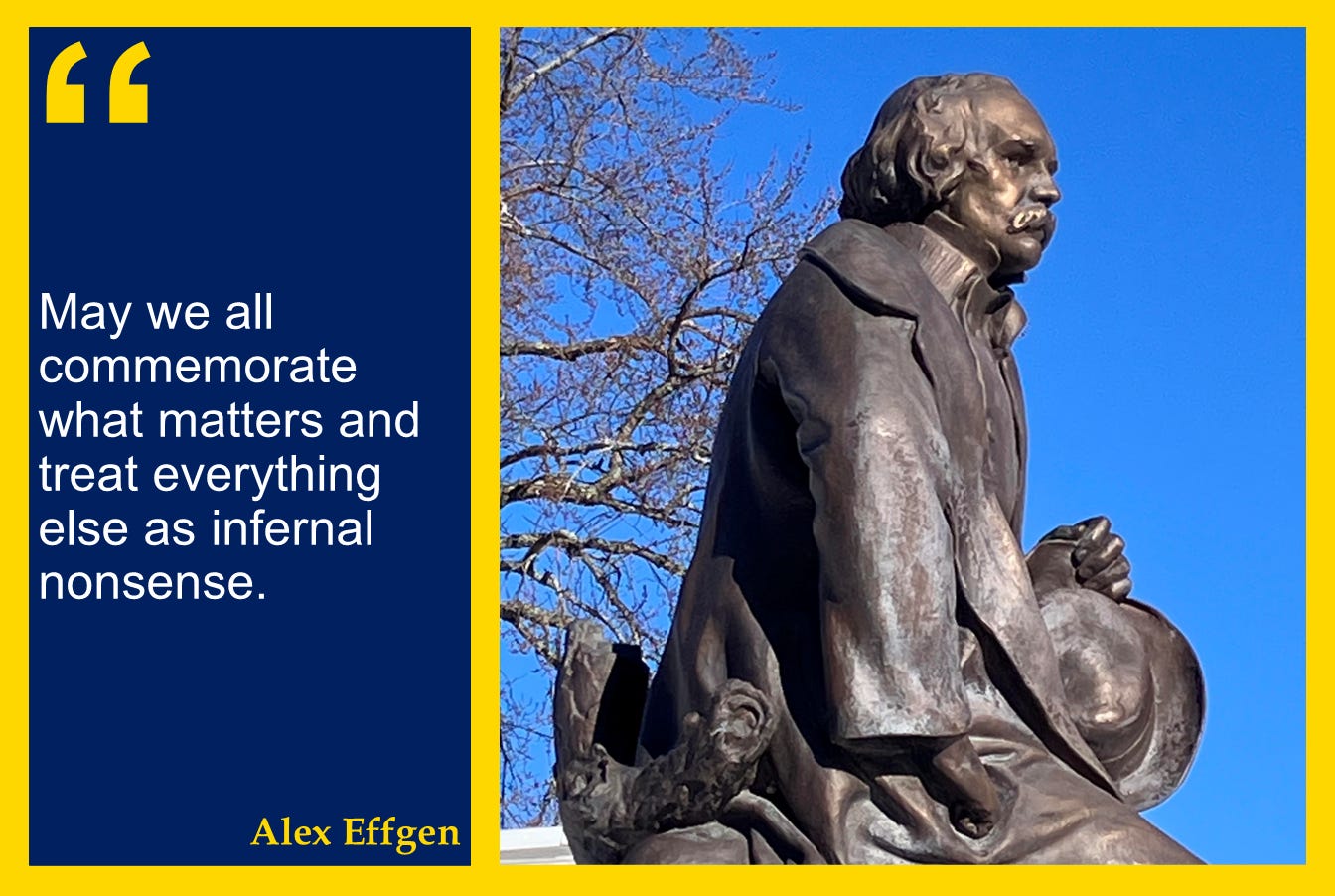
I count myself lucky. To have spent the last twenty of Salem’s 400 years raising young men as equals in a world of imagination–of nature and freedom–more real than our present reality. May we all commemorate what matters and treat everything else as infernal nonsense.
In Related News…
Speaking of anniversaries, holy cow does The Future Indicative have one to share this week!
The Future Indicative, Ep 6 Part 1
The Future Indicative, Ep 6 Part 2
Last week I mentioned talking to my friend Rob McIsaac about motorsports. Next month (March 6th and 7th), at Daytona International Speedway, Rob’s company, RPM Ventures NC, is commemorating the 50th anniversary of BMW’s win at the inaugural AMA Superbike race in 1976. RPM Ventures is bringing many of the winning BMW racers and engineers, as well as the original BMW R90S motorcycles in their Daytona Orange, back to the place where they crushed the competition.
Today’s episode of The Future Indicative will test its Four S of business on the racetrack, and Rob–as our historian and expert in all things vehicular–will take us on a ride around the industry of speed.
On your mark! Get set!
Alex Effgen