

The Present Indicative, 30 June 2026
My Current Mood: This Was Scotland

The platform remains free (and worth it) but in case you’re feeling philanthropic, I’ve set up a subscription page!

Scots, wha hae wi’ Wallace bled,
Scots, wham Bruce has aften led;
Welcome to your gory bed,
Or to victory!
Scots Wha Hae
Last year my son’s local soccer league sent word that FIFA was looking for volunteers for the 2026 World Cup. The message was received at the end of July, and coincided with the corporate restructuring that liberated me from full-time employment. With the matches to be held in Boston between June 13-July 9, I could not fathom being free to volunteer almost one year later, but I had no crystal ball to navigate the great unknown. It was early days drawing severance and applying my fingertips to cover letters. What was one more application for a possible story?
If this sounds familiar, then I want to thank you for following along since last year. Let us close this chapter where we left off: I applied. There was a portal. FIFA provided several stages winnowing the wheat from the chaff. In November I was invited to Team Tryouts that took place in early December: a day of orientation, ice breakers, team building, and role playing. They would make their selections in January. Then February. Then March. April was quiet. I sent an inquiry and was told volunteers would be notified over the next few weeks. When they finally thanked me in May for my time with regret to inform me that I did not reach the next stage of selection, I was grateful. One month of training to host the largest sporting event in history seemed a tall order for volunteers.
Oh, I still would have done it. To be one of the elected from a million applicants would have been epic, and exhausting, as I’ve been building this brand and not only the content you read with it, but a freelance funnel aligning my services with the needs of those who agree with our values. One month before any tourist would have to find Boston Stadium on a map, it was a relief for me as much as a responsibility for someone else to direct them 35 kilometers southwest to Foxboro.
And then the kilts arrived.
“Work smarter, not harder.” - Scrooge McDuck
We call it soccer. Not football. And prior to this World Cup, America’s attention to the sport of the future had been novel at best and contemptuous the rest of the time. Which is odd for a country where millions of children play soccer as their formal introduction to team sports. You’d think we could field an unstoppable team of eleven given the resources, but US (Men’s) Soccer has lacked the infrastructure to work smarter, not harder.
I first learned this lesson from Disney’s Scrooge McDuck. After a long day in elementary school, waiting for my fish sticks to crisp in the microwave and stirring my Nestlé Quick in a tall glass of cold milk, I would watch The Disney Afternoon instead of practicing soccer. For the uninitiated, DuckTales anchored a daily block of animation, and introduced a generation of Americans to the Scottish.
Scrooge began his cartoon life as a bit of a stereotype, popularly featured in Disney comics beginning in the late ’40s. He starred in Mickey’s Christmas Carol, a featurette that I honestly thought was produced a lot earlier than 1983. But that makes him a featured player in the pop culture of children familiar with E.T., Indiana Jones, and The Goonies. Four years later, Disney reinforced his place in the younger Gen X/older Millennial zeitgeist as the protagonist in DuckTales, raising his three nephews while Donald was in the Navy.
Why does this matter? Because Scrooge and his animated antithesis (Flintheart Glomgold), along with Groundskeeper Willie a few years later on The Simpsons, were the primary portrayals of Scots in American popular culture in the late ’80s. Granted, Canadian James Doohan played Scotty periodically in the second half of the 20th Century, but Star Trek was set in the future, not the present. And our present is informed by the past.
One out of ten Americans claim Irish ancestry, thanks in part to a potato famine and the Catholic mandate to be fruitful and multiply. This means Americans have an innate familiarity with Irish custom. But the Scottish with their Protestantism have not needed to be so fruitful, nor flee religious persecution. They have not made as conspicuous a mark as their Hibernian kin on the American present. These Scots caricatures were the primer for a brogue on the tongue and a kilt around the waist.
“Alright, give your mother a kiss or I’ll kick your teeth in!” - Stuart MacKenzie
The groundwork laid by cartoons would be reinforced by comedy. Billy Connolly replaced Howard Hesseman on the ABC sitcom Head of the Class in 1990. In Season 17 of SNL, Mike Myers introduced his All Things Scottish sketch, which informed the patriarch of the MacKenzie family in Myers’ 1993, So I Married an Axe Murderer, which evolved six years later into Fat Bastard in Austin Powers: The Spy Who Shagged Me, and then indelibly defined Shrek in 2001 and beyond.
We’re 14 years past Duck Tales by the start of the 21st century, and the Scots had become a popular brand. Movies like Braveheart and Rob Roy (both 1995) had made them dramatic, rounding out the comedic stereotypes of cheap drunk belligerents into combative passionate patriots. Myers brought all of these attributes to the first Shrek movie. And while I must confess, I am not a fan of that series of films, I can respect its impact on younger generations. So when the rumors started around Boston a couple weeks back that people were seeing Scots…in kilts…
“The best laid schemes o’ Mice an’ Men | Gang aft agley,” - Robert Burns
…It was like Hollywood had invaded Boston. And I don’t mean film production; we’re used to that happening here. I mean actual film characters had come to life and invaded Boston. We’re a quarter of a century into the 21st. The building blocks of comedic and dramatic Scottish representation had matured to include dwarves for some and Outlanders for others. But what hadn’t really dawned on Bostonians was that we were hosting a World Cup. And Scotland, who had not been to a World Cup since 1998–a year before Fat Bastard–was about to have two group matches outside Boston in the first week of play. We were about to find out if America’s immoveable antipathy towards professional soccer would bend to the irresistible force of a travelling Tartan Army.
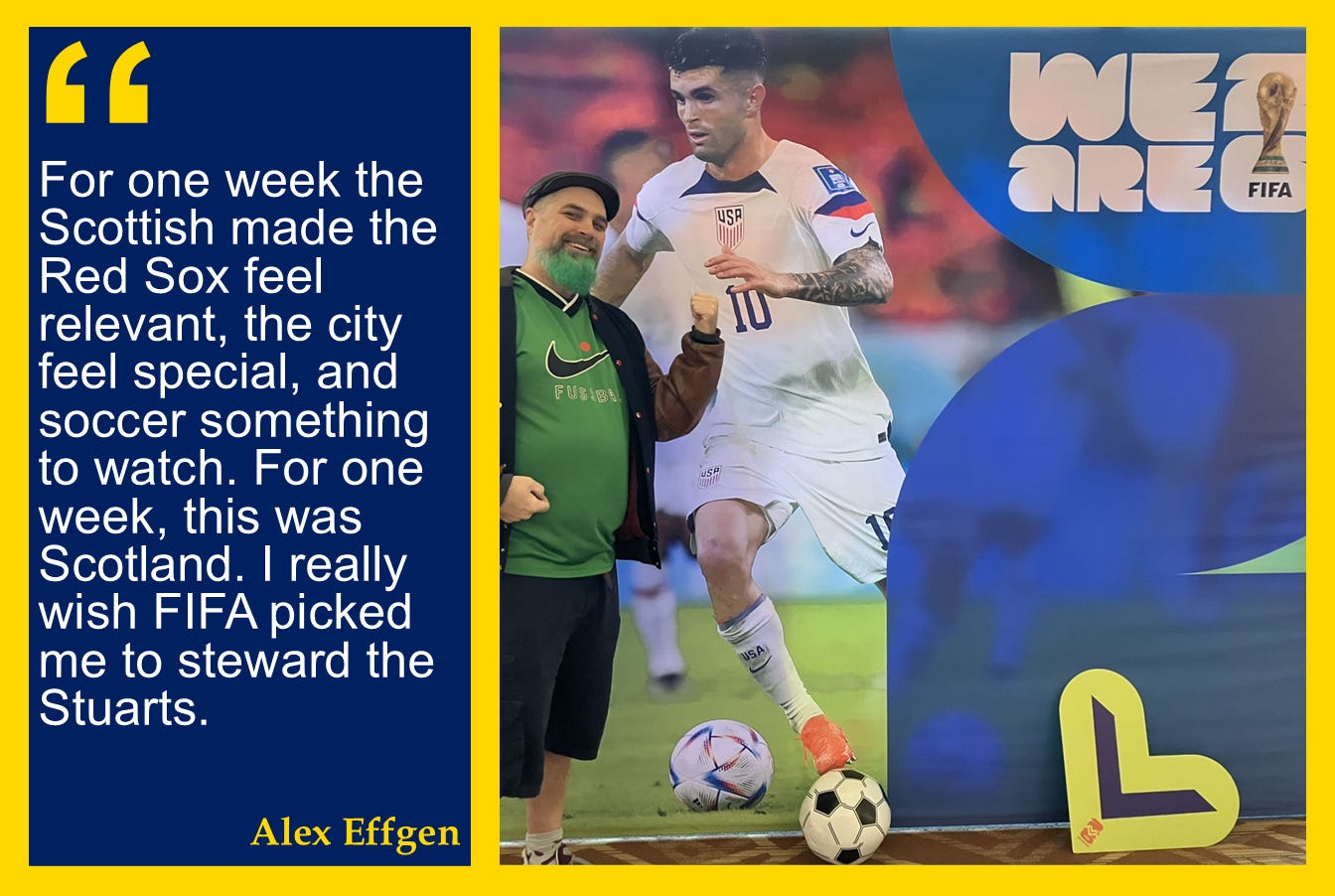
It started at Cheers. A place where everybody knows your name but hasn’t been culturally relevant since 1993. I witnessed firsthand a torrent of tourists in blue tops and plaid bottoms–one stream pouring from the front of the Bull & Finch Pub crossing to the Public Garden, and the other stream coming from the Public Garden and pouring into the Bull & Finch. They were everywhere. And they drank everything. And while reports came in that our supply of alcohol might not accommodate the demand, for one week the Scottish made the Red Sox feel relevant, the city feel special, and soccer something to watch. For one week, this was Scotland. I really wish FIFA picked me to steward the Stuarts.
In Related News…
But they didn’t. Speaking of international gatherings, next week The Future Indicative connects with Kate Morgan, the CEO from Boston Human Capital Partners, to talk about resourcing. Human resourcing. She had just returned from the Global Leadership Conference of the Entrepreneurs’ Organization, held in Dublin. And as it was top of mind for her, she shared the benefits of community gathering for us:
We had 2,000 people in attendance. And these are all entrepreneurs that are running small businesses, from all over the globe. And there was loads of interesting dialogue happening. We had keynote speakers. But I think it’s just the unity of founders and entrepreneurs coming together. What most people do not realize is how bloody hard entrepreneurship is. In order to be part of EO, you have to have a million dollars or more. The number of companies that actually get over a million is 4%, and I would argue that it’s less than 4% now because we had so many folks exiting, doing solopreneurship. And as a solopreneur, it’s very hard to get over a million, let alone have a team. I haven’t looked up that number to see where it is today, but I would guess that even less get over a million.
It can cause a lot of insecurity when you are running a company. And we’re here because our teams expect us to be “Greater than thou,” right? Like, we think about our parents. Growing up, we see them as infallible. Even though some of our parents could have been jerks, we see them as being so powerful.
And I think the level of expectations we see from employees of what we’re allowed to do, we’re still only human. And so just to have that sort of human interaction and support…Not that we’re all needing therapy and stuff, but it’s just really having that sort of community is super important.
We all need community. And hopefully, that’s why you’re here reading this. Some of the topics we cover include:
“Ode on a Grecian Urn,” by John Keats
The Great Knowledge Transfer, by Meredith Barnes-Cook and Steven Kaye
Simple Numbers, by Greg Crabtree
The Anxious Generation: How the Great Rewiring of Childhood Is Causing an Epidemic of Mental Illness, by Jonathan Haidt
And if you’re mourning Scotland’s exit from the Group Stage, and want to revisit their magic week in Boston…
Why are Scotland fans putting traffic cones on statues in Boston?
Cheers!
Alex Effgen